
Curriculum · September 2, 2026 · 9 min read
The Moment It Became Real
There are moments in building something when you realize you are no longer imagining what it could become.
You are looking at proof.
That happened to me this week.
I recently created my first TTG repair pack. The purpose was simple: identify a foundational skill that was interfering with the current lesson, step away from the new content long enough to repair that gap, and then return to the work with a stronger base underneath it.
I believed in the idea when I built it.
Yesterday, I got to watch it work.
After a few very small reminders, my student started moving through the work. Not guessing. Not waiting for me to walk him through every step. Not staring at the page with that familiar look that says, “I have no idea what I am supposed to do.”
He started zooming.
And I sat there watching it happen.
That moment meant more to me than I expected it to.
Because I realized I was not simply looking at a completed assignment.
I was looking at evidence that the repair pack had done exactly what I designed it to do.
It worked.
The problem was never just the problem in front of him
This is something I have believed for a long time as a teacher and tutor: the mistake on the page is not always the actual problem.
A student can struggle with proportional relationships because fractions are shaky. A student can struggle with algebra because integer operations are not automatic. A child can appear confused by new material when the real issue is that an older skill was never fully mastered.
If we only reteach the current lesson, we may never touch the reason the student is struggling in the first place.
That is why I started building repair into the curriculum intentionally.
Not as an extra worksheet.
Not as busywork.
Not as punishment for getting something wrong.
As part of the instructional design.
The repair pack exists to answer a different question:
What does this student need underneath this lesson in order to move forward successfully?
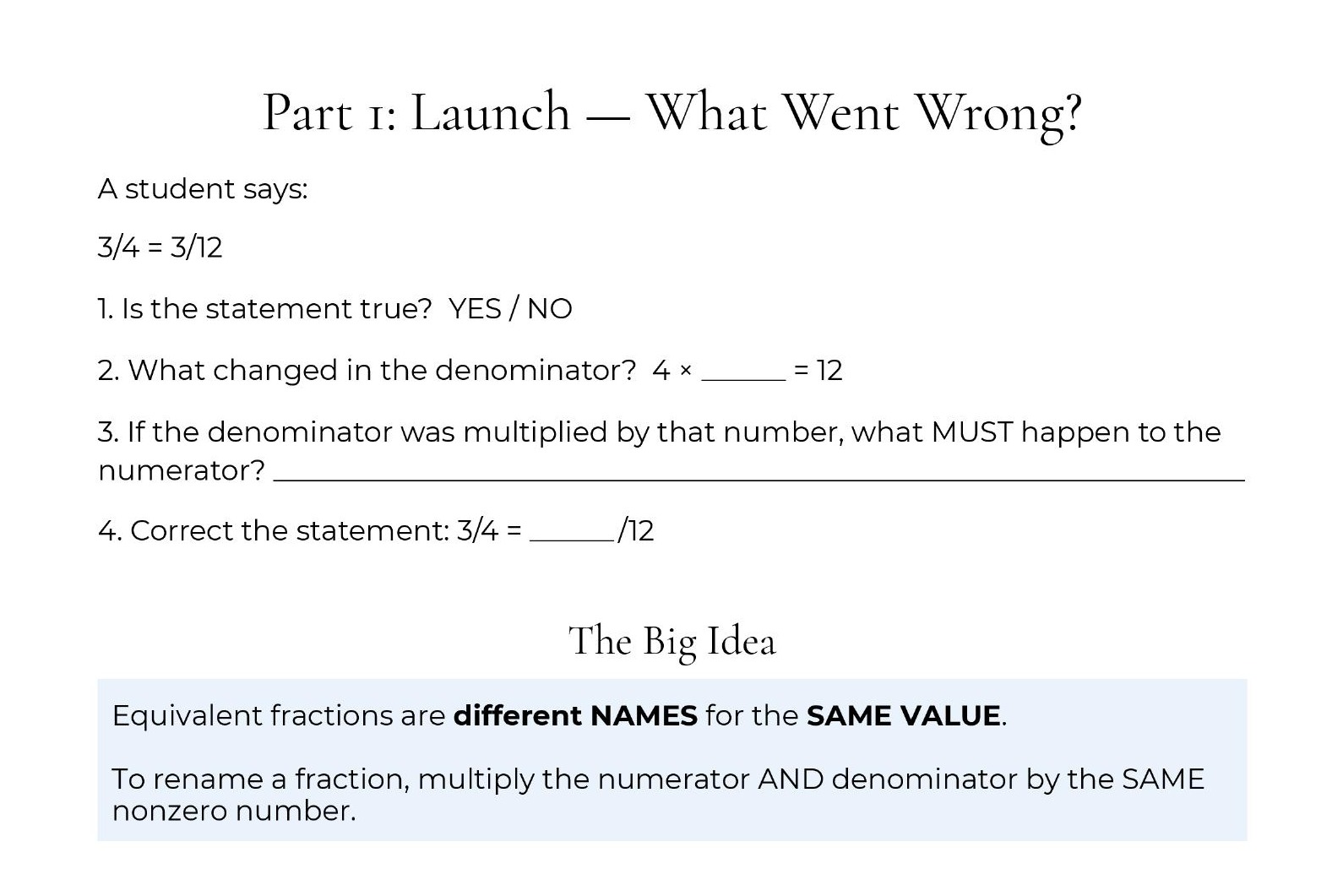
Yesterday, I got my first real answer.
It worked.
That sounds small. It did not feel small.
I am almost emotional writing that sentence.
It worked.
I have spent months thinking about what I want Teach the Geek curriculum to be. I have thought about rigor, misconceptions, readiness checks, guided reasoning, intervention, teacher supports, repair work, meaningful practice, and the difference between a student completing something and actually understanding it.
I have been building page after page around one principle:
Nothing should be filler. If it is in the lesson, it should have a job.
The repair pack had a job.
And it did it.
That feels different from saying, “I made curriculum.”
Now I can say that I built an instructional tool, used it with a real student, and watched the student become more independent because of it.
That is tangible.
That is measurable.
That is the kind of evidence I have been hoping to see.
The work worked because we worked together
There is another part of this story that matters deeply to me.
The repair pack worked, but it did not work in isolation.
My student’s mother has been incredibly consistent throughout this process. She communicates when he cannot attend. She makes sure he comes to sessions. She has him review materials at home. She follows through.
That matters.
Her consistency gives the work we do in tutoring somewhere to continue after the session ends. It reinforces the expectation that learning does not stop when the hour is over. It tells her child, through action, that this work matters and that the adults around him are working together.
That is what the relationship between educator and parent is supposed to look like.
Not blame.
Not one side carrying everything.
Partnership.
Her efforts make my efforts more effective, and I want to say that plainly because families deserve credit when they are doing the work too.
And then there is my student.
I am so proud of him.
The growth I have seen is not only academic. I am watching confidence form.
That may be one of the most meaningful parts of all of this.
There is a difference between a student who is completing work because an adult is guiding every move and a student who begins to recognize the process for himself. Lately, I have watched him naturally say things I have taught him. I have watched him use strategies without being prompted. I have watched him approach work with more confidence than he had before.
Those moments stop me.
Because that is when you realize the teaching has moved beyond the lesson.
It is becoming his.
That is the goal.
Not dependence on the tutor.
Not memorizing what I say.
Ownership.
I want my students to eventually hear my voice in their heads without needing me sitting beside them. I want them to recognize the pattern, ask themselves the question, use the strategy, and move forward.
Watching that begin to happen has honestly blown my mind.
This is the part that has me emotional.
The repair pack worked.
The teaching is sticking.
The parent partnership is working.
And the student is growing into the kind of learner I hoped the curriculum would help create.
This is why I care so much about the why
There are easier ways to create educational resources.
I could make attractive worksheets, add answer keys, bundle them together, and move on.
But that has never been enough for me.
I want to know why the student is making the error.
I want to know what skill is missing.
I want to know whether the student can explain the reasoning.
I want to know whether the understanding survives when the question changes.
I want to know what happens after the student gets stuck.
That is what the TTG curriculum is being built around.
The goal is not simply to create work for students to complete.
The goal is to create instruction that responds to what students actually need.
Yesterday was the first time I got to see one small piece of that vision prove itself in real time.
And I am still sitting with what that means.
Then came another realization
At almost the same time, something else happened.
The repair pack became my first item ready for Teachers Pay Teachers.
And the TTG store on my own website is about to open.
That sentence feels surreal to write.
For a long time, the curriculum has existed in binders, Google Docs, Canva files, lesson maps, student sessions, and a very large collection of ideas in my head.
Now it is becoming a product.
Something another teacher can use.
Something another tutor can use.
Something a parent may one day use to help a child repair a skill.
Something that can exist beyond the students sitting directly in front of me.
That is a major shift.
I am watching the work move from private creation to public resource.
And I do not think I fully understood how much that would mean to me until now.
This is the part people do not always see
When people see a finished resource, they see the final pages.
They do not see the hours of thinking behind the sequence.
They do not see the moment where I decide a question is not doing enough and rewrite it.
They do not see the lesson map, the prerequisite skills, the misconceptions, the teacher notes, the repair decisions, or the dozens of tiny choices underneath the final product.
They definitely do not see me sitting at a table watching a student suddenly move through work that had been difficult before and trying not to lose my mind because the thing I built actually worked.
But that is the part I want to remember.
Because business growth is exciting.
A store opening is exciting.
The first sale will be exciting.
But this moment came first.
The curriculum worked.
This is only the beginning
One successful repair pack does not mean every resource I create will be perfect. It does not mean every student will respond the same way or that every instructional problem has one simple solution.
It does mean the design philosophy has something real behind it now.
It means I have a result I can build from.
It means the next repair pack will be informed by what I saw in this one.
It means the curriculum can continue becoming stronger because it is being tested against actual student learning, not just what looks good on a page.
And more than that, it reminded me that no piece of curriculum works alone.
Good teaching matters.
Good materials matter.
Consistency matters.
Parent partnership matters.
Student effort matters.
When those things begin working together, growth stops being theoretical.
You can see it.
You can hear it in the way a student talks through a problem.
You can see it in how quickly they recover from a mistake.
You can feel it in the confidence that starts replacing hesitation.
That is what I saw this week.
Teach the Geek has been growing for a while, but this week I got to see one of the clearest signs yet that the work itself is growing too.
I built something.
A student used it.
His mother reinforced it.
He learned from it.
And it helped.
For me, that is everything.
Behind the Glasses
Teach the Geek
Behind the Glasses
A weekly look at education, learning, careers, community, and the ideas shaping Teach the Geek.
Learn. Grow. Achieve.
Start a conversation